
Case Studies
![]() |
![]() |
![]() |
Mobile Studios designs new SD/HD broadcast and recording system for US House of Representatives |
|
When not in the Capitol Building for a full session, the US House of Representatives has its offices and committee meetings next door in the Rayburn Building. Any recordings done in this building are handled by the House Recording Studio. This group creates and distributes broadcast content across Capitol Hill on their own network. When the time came to replace some of their recording equipment, Mobile Studios won the contract to build three new systems. While the House Recording Studio presently records only in SD, the cameras and equipment in our systems are all HD quality, so when the House decides to begin broadcasting in HD, all the equipment can be instantly converted. |
|
Click for Larger Image |
|
Three PortaCast® Mobile Studio systems with equipment cases ready for delivery. |
|
For this job, we decided to go with Panasonic components. Using the powerful AV-HS400A switcher and AW-RP655 robotic controller as the heart of this system, each Mobile Studio was designed with a simple workflow that allowed one person to operate the entire console. These Mobile Studio systems would not be allowed in the meetings rooms, so it needed to be set up in the hallway outside the room. To minimize the space required for each camera setup, the versatile Panasonic AW-HE870N camera mounted on the AW-PH360 robotic head were chosen, and equipped with a fiber optic interface to transmit back to the Mobile Studio. |
|
Click for Larger Picture |
Each of these cases holds all the camera equipment for each PortaCast® Mobile Studio |
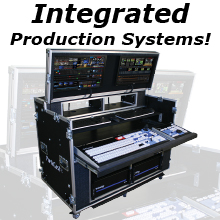
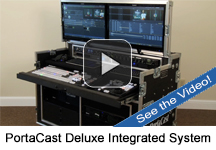
The PortaCast® Mobile Studio designed for the US House of Representatives |
Because each of the studio units is required to be set up in the hallway outside the committee room it is videotaping, and given that the doorways in the Rayburn were narrower than most, we needed to design the Mobile Studio to be as narrow as possible. Cutting every possible inch of depth out of the case, we brought the system footprint to a bare minimum, allowing the House Recording Studio to work without blocking the hallway. |
|
Click for Larger Picture |
A House Recording Studio engineer monitors the committee meeting, moving the robotic cameras to cover each person while applying graphics when necessary. |
The control surface of the House Recording Studio PortaCast® allows one person to comfortably operate the entire studio comfortably and efficiently. |
The fiber equipment used in the Mobile Studio required good airflow to dissipate all the heat they generated, so we designed the layout to be as open as possible. Each component was separated, and the cables were bundled or moved out of the way so the system could get the maximum possible airflow. Looking at the rear access in the above picture, you can see the spacing of the components and the basic layout of the Mobile Studio. The Viper unit at the front of the unit takes the optical lines and converts the information back into separate audio, video, and data outputs. Individual lines carry this information throughout the Mobile Studio. One of the program outputs is sent to the Evertz transmitter, which converts the signal back to fiber and sends the information to the main office, where it is broacast to every office on Capitol Hill. |
|
Click for Larger Picture |
The PortaCast® Fiber Throw-down Camera Pak set up under a robotic camera tripod. |
Detailed interior of the PortaCast® Fiber Throw-down Camera Pak |
This is the unique Fiber interface designed for the House systems. They wanted a simple way to convert the SDI signal to optical for the run back to the main unit, so we developed a self-contained unit that handled all this and fit under the camera tripod to be out of the way. We took a standard aluminum briefcase and mounted the power supply for the camera and a Telecast throwdown module inside. Using a custom harness, audio and data were combined with the video in the Telecast module and sent back to the Mobile Studio. A total of twelve units were built, one for each camera. All the necessary cables for camera operation are contained within the Fiber Throw-down Camera Pak, mounted to the side of the case. This harness also includes two redundant SDI cables (3 total), in case the active one fails. |
|
Click for Larger Picture |
While this House committee discusses climate change, robotic Panasonic cameras catch everything.
|
Rich Rubin congratulates Chief Engineer Alex Cusati and Engineering Operations Manager Darryl Atchison on their new PortaCast® Mobile Studio |
The Mobile Studios PortaCast® modular system for the US House of Representatives was delivered with the following integrated components: |
|
(3) PortaCast® Mobile Studio MS-P400W
(3) PortaCast® Equipment Cases, each containing:
|
|